How it
works:
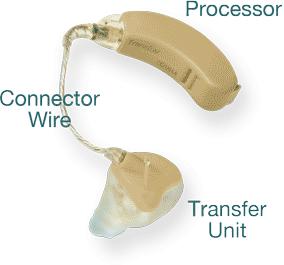
Just like a conventional hearing aid, a custom shell is made to
fit in the ear canal. However, unlike a conventional aid that
would simply amplify the sound, TransEar has a miniature
vibrator embedded in the shell. When sound is "received" on the
side of the dead ear, it is converted to mechanical energy that
drives the oscillator. Those signals are then transferred via
the bones of the skull to the cochlea in the opposite ear.
All of this happens nearly instantaneously, but your brain knows
the difference. It learns to distinguish between sounds coming
in on the side of the good ear versus sounds coming in from the
opposite side.
The ability to determine the specific source of a sound - left
side / right side, front / back, and everything in between - is
called sound localization, and many TransEar users report that
they have regained this ability with TransEar.
Will TransEar work for
me?
TransEar's effectiveness depends on a specific threshold of
hearing in the "better" ear, so your hearing healthcare
professional will evaluate your hearing in both ears. (See
"Indications for Use") Each patient's physiology and medical
conditions may also be factors in the fitting.
Important note: Because there may be an underlying condition
requiring medical treatment, it's important to report the onset
of SSD to a medical professional such as an ENT doctor or
otologist for a thorough examination. Your doctor may in turn
work with a hearing healthcare professional to determine if
TransEar is appropriate for your type of hearing loss and
medical considerations.
TransEar features a
4-channel digital processor with a high power output stage which
drives the oscillator in the transfer unit.
Program 1 (P1) for normal listening and Program 2 (P2) for
comfort in noise have each been engineered and
factory-programmed to maximize the frequency response
characteristics for bone conduction. Additional adjustments may
be made by a hearing healthcare professional with TransEar's
fitting software.
Program indicator tones and a low battery indicator tone are
also standard features of TransEar. |
|